> ## Documentation Index
> Fetch the complete documentation index at: https://encrova-docs.platform.ai71services.ai/llms.txt
> Use this file to discover all available pages before exploring further.
# Folders
> Learn how to organize secrets with folders.
Encrova Folders enable users to organize secrets using custom structures dependent on the intended use case (also known as **path-based secret storage**).
It is great for organizing secrets around hierarchies with multiple services or types of secrets involved at large quantities.
Encrova Folders can be infinitely nested to mirror your application architecture – whether it's microservices, monorepos,
or any logical grouping that best suits your needs.
Consider the following structure for a microservice architecture:
```
| service1
|---- envars
|---- users
|-------- tokens1
|-------- tokens2
| service2
|---- envars
...
```
In this example, we store environment variables for each microservice under each respective `/envars` folder.
We also store user-specific secrets for micro-service 1 under `/service1/users`. With this folder structure in place, your applications only need to specify a path like `/microservice1/envars` to fetch secrets from there.
By extending this example, you can see how path-based secret storage provides a versatile approach to manage secrets for any architecture.
## Managing folders
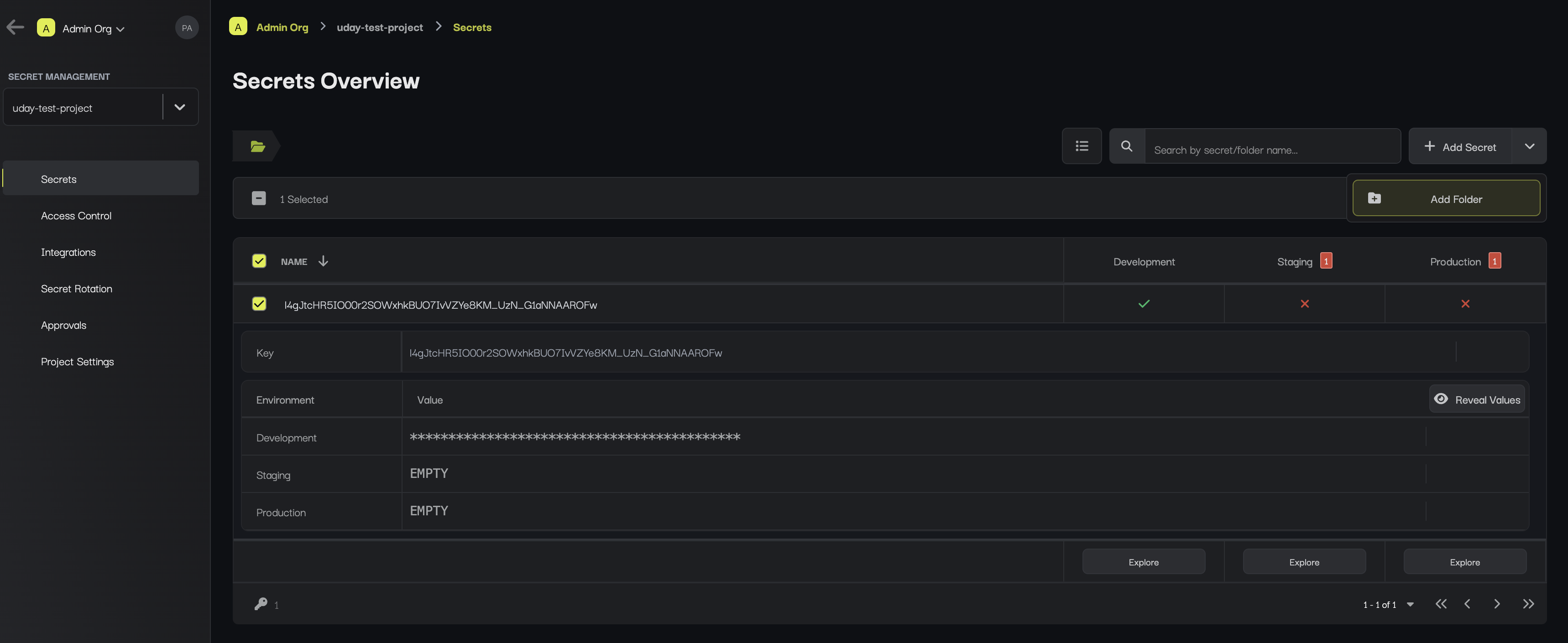
To add a folder, press the downward chevron to the right of the **Add Secret** button; then press on the **Add Folder** button.
Folder names can only contain alphabets, numbers, and dashes
 ### Comparing folders
It's possible to compare the contents of folders across environments in the **Secrets Overview** page.
When you click on a folder, the table will display the items within it across environments.
In the image below, you can see that the **Development** environment is the only one that contains items
in the `/users` folder, being other folders `/user-a`, `/user-b`, ... `/user-f`.
### Comparing folders
It's possible to compare the contents of folders across environments in the **Secrets Overview** page.
When you click on a folder, the table will display the items within it across environments.
In the image below, you can see that the **Development** environment is the only one that contains items
in the `/users` folder, being other folders `/user-a`, `/user-b`, ... `/user-f`.